Buyer-question map
50–150 category, comparison, problem and vendor prompts mapped to the decisions your market is already making.
Independent AI visibility audit
See whether ChatGPT, Claude, Gemini and Perplexity mention, cite or recommend your brand across the questions that shape a real shortlist. Get the evidence and the fixes in five business days.
01 / The blind spot
The answer is assembled off-site, often without a click. That makes traditional attribution quiet at exactly the moment a buyer is learning your category, comparing vendors and deciding whom to trust.
02 / The evidence system
Every conclusion is traceable to a prompt, model, run date and raw response.
50–150 category, comparison, problem and vendor prompts mapped to the decisions your market is already making.
Mention, citation and recommendation rates across four answer engines—repeated three times to expose variance.
A prompt-level view of who owns the answer, which sources lift them, and where your brand disappears.
Dated answer excerpts documenting stale facts, hallucinations and category confusion before they become buyer truth.
Crawler access, schema, entity consistency, source consensus, content structure and freshness—checked, not guessed.
The highest-leverage fixes ordered by evidence, effort and expected visibility impact for your team to execute.
Free technical signal check
Enter your domain. We inspect crawler access, metadata, schema, answer structure and discovery files—then return a scored, prioritised diagnostic in the browser.
Check my site03 / From question to action
Five minutes. Your site, category, buyers and known competitors. No discovery call.
Up to 1,800 scored answers, clean sessions, fixed rubric, named models and dated evidence.
Report, raw answer export, interactive dashboard and a sequenced remediation roadmap.
04 / See the work
Explore real category data, expand prompt-level findings, inspect citation sources and ask the dataset a question. The sample is not a decorative mockup.
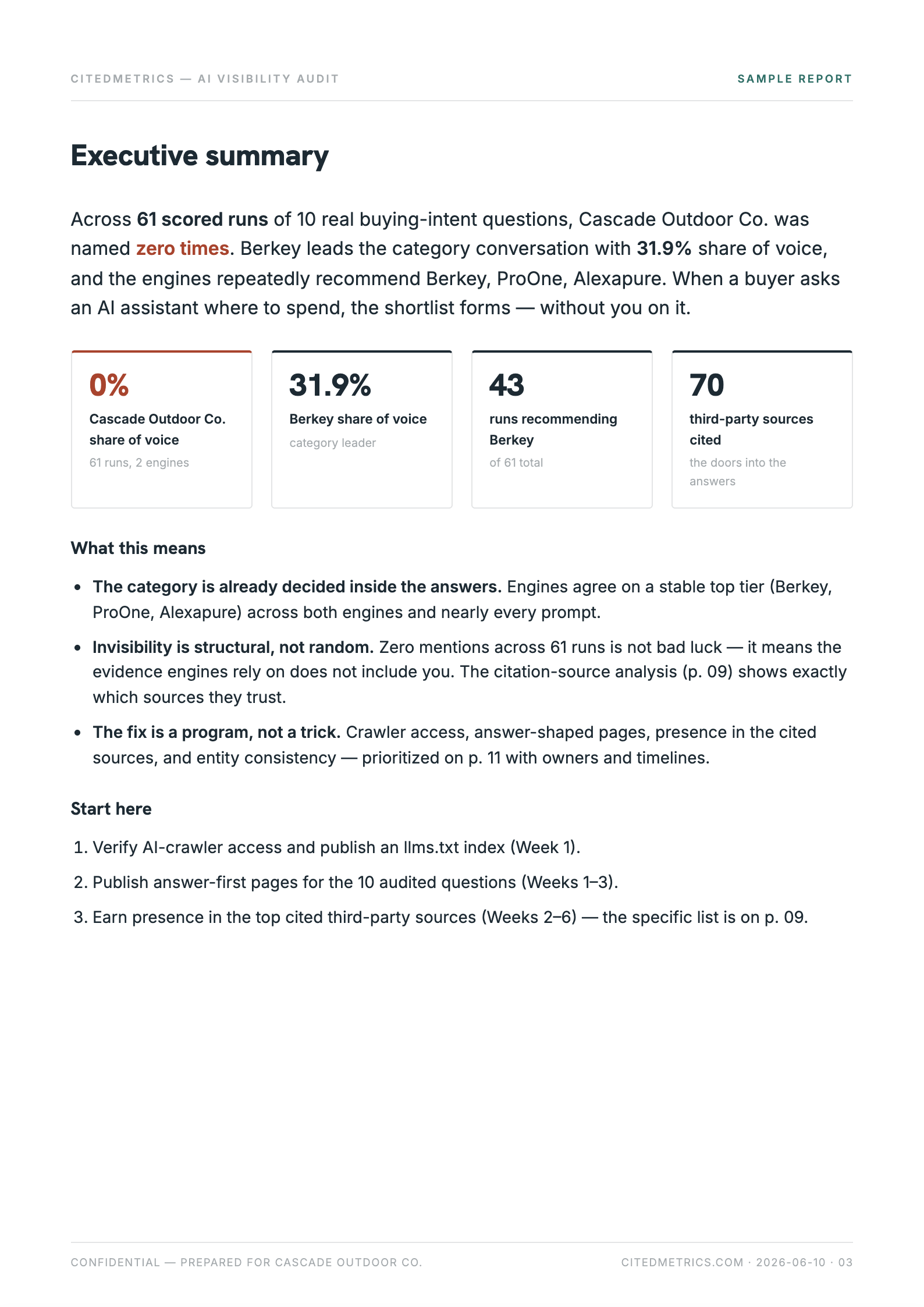
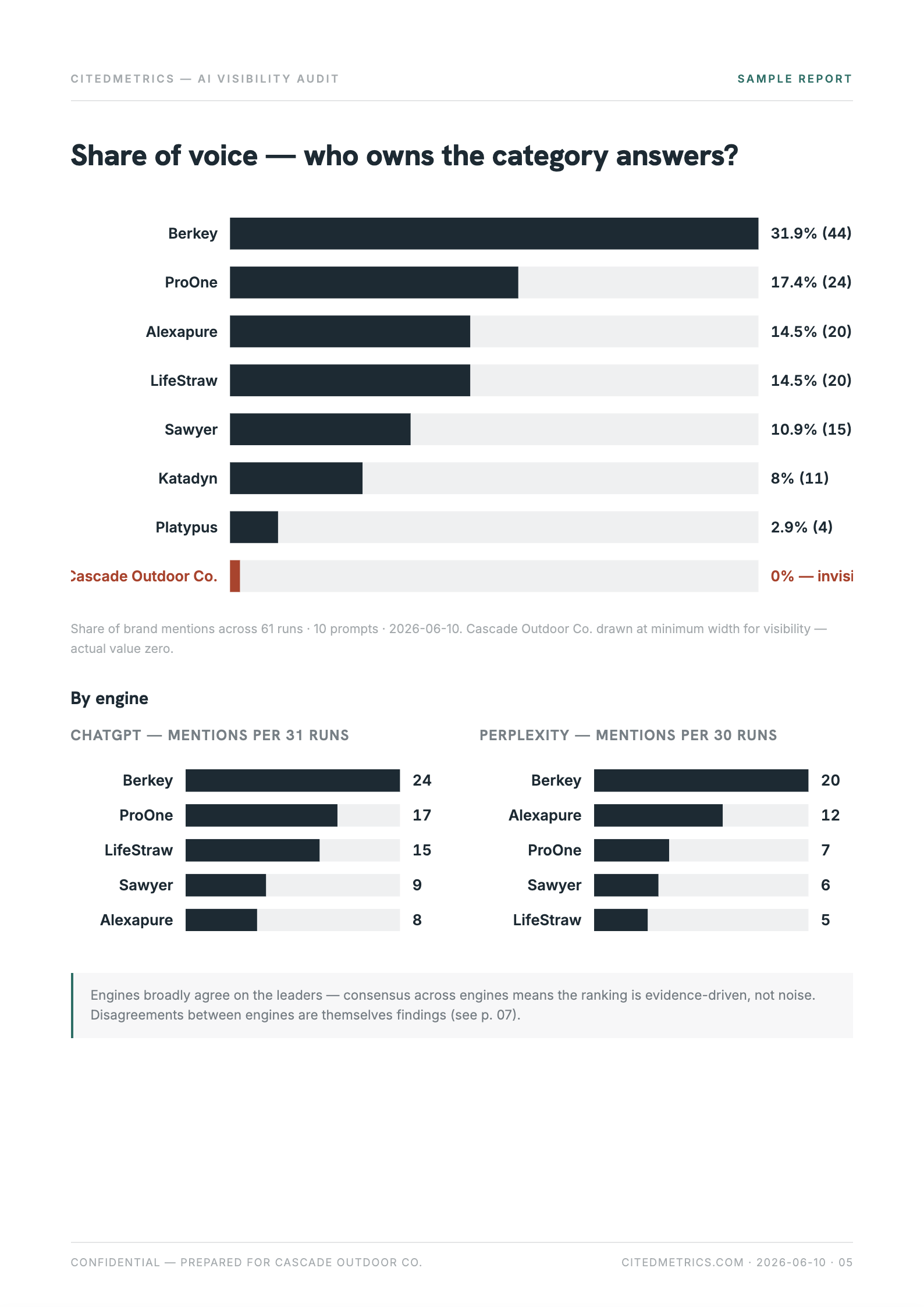 15 pages · raw evidence · action sequence
05 / Measurement discipline

Why I built this ↗“I came from aerospace manufacturing, where a confident claim without evidence was a process failure. CitedMetrics applies the same discipline to a new, opaque buying surface.”
06 / Open evidence library
Our research desk publishes the definitions, market data and diagnostic sequence behind the service. Read it, challenge it, and use it whether or not you commission an audit.
A free manual method for building buyer prompts, opening clean sessions and recording whether each engine mentions, cites or recommends you. It also explains where a small manual sample becomes misleading.
Read the guide ↗Diagnostic · 11 minFive checkable causes in the order we investigate them: blocked discovery, missing answer pages, weak third-party evidence, inconsistent entity facts and category confusion.
Run the diagnosis ↗Original research · 13 minA transparent market survey of one-time audits, monitoring tools, enterprise platforms and agency retainers—plus the prompt volumes and evidence standards hidden behind similar-looking prices.
Inspect the market data ↗Our editorial rule is simple: direct claims should be traceable to a named source, original dataset or reproducible method. Corrections remain visible rather than disappearing into silent updates.
Browse every guide and study →07 / Choose the evidence level
Choose the lowest-friction next step that answers the question you have now.
One domain. Twelve technical signals. An immediate scored action list.
$0Run the checker →50–150 buying questions, four engines, repeated runs, competitors, raw answers and a 90-day plan.
$950 onceBuy the audit →Useful after the baseline when a team is ready to monitor and maintain the improvements.
Ongoing feeCompare the market →07 / Fixed scope, fixed price
No subscription, no sales call and no platform to learn. Your report and raw export are yours.
Compare the 2026 market →Secure checkout via Stripe · Visa · Mastercard · Amex · delivered in 5 business days · 14-day usefulness guarantee
AI engines synthesize answers from sources they trust instead of ranking ten links. We measure whether you're inside those answers and diagnose why not — content structure, entities, schema, AI-crawler access. It overlaps SEO; it isn't SEO.
ChatGPT, Claude, Gemini and Perplexity — current production models, named with versions and run dates in your report.
That's exactly why every prompt runs 3 times and variance is reported. A single run is an anecdote. An averaged, dated baseline is a measurement.
Then the audit shows where you win, where you lose, to whom, and why. Most brands are partially visible — and unaware of which buying prompts they lose.
A 20+ page PDF: visibility baseline, competitor share-of-voice, sentiment and hallucination findings with evidence, technical root-cause analysis, and a prioritized 60–90-day roadmap — plus the raw scored data.
Optionally, yes. A remediation retainer from $1,500/mo implements the roadmap and re-measures monthly — and your audit fee credits toward the first month. The audit also stands alone; many clients hand the roadmap to their own team.
You don't have to take our word: the methodology is published above, every finding links to raw engine output, and the keep-the-report guarantee means a useless report costs you nothing.
Yes. Your report, prompts and results are never shared, resold, or used in our marketing without written permission.
Evidence changes the conversation.